Dead and forgotten

I’ve recently been playing Type Help.
In the game, there are a number of characters that inhabit different locations in the setting, and time is sliced up into chunks wherein each character performs some atomic scene.
In an effort to clarify my own understanding of the game, I’ve decided to create a diagram of the locations of the characters over time.
Location syntax§
The game is divided into scenes, which are identified by a time-slice, an area code, and a list of scene participants. Time slices begin at 01 and end at 26, as far as I can tellThere are scenes marked with time-point 00, but these appear to be in some sense outwith the story, at time of writing. ↩. A scene taking place at the fifth “moment”, located in a placed called the “Tower”, involving the third, fourth, and eight person, would be notated “05-TO-3-4-8”.
Automatic representation§
So far, I have found these locations:
LIST
1 2 3 4 5 6 7 8 9 10 11 12 13 14 15 16 17 18 19 20 21 22 23 24 25 26 27 28 29 30 31 32 33 34 35 36 | |
This is a lot! In order to avoid wasting timeNotably, one can avoid wasting time and in-so-doing spend more time achieving the same outcome. ↩, I wanted to automate the procedure of converting location names to diagramma.
In order to do this, I wrote a script in Rust that ingests a list of location names, and constructs a Typst document that compiles to such a diagram.
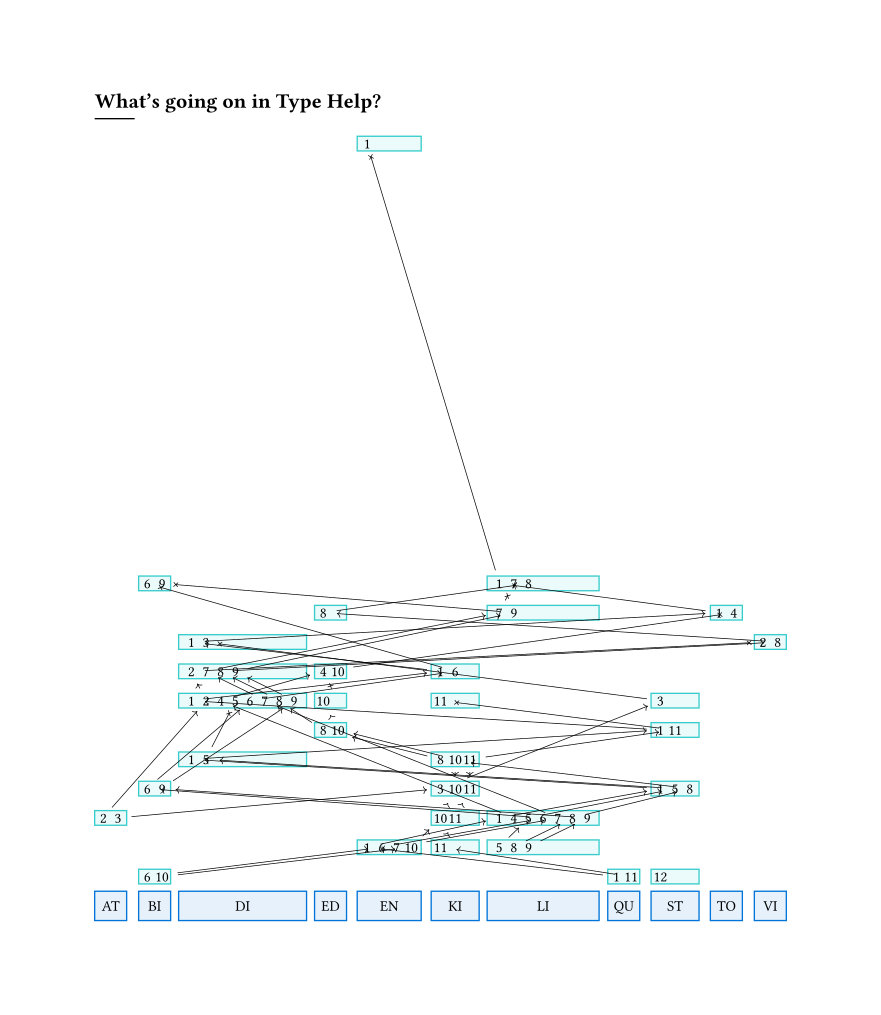
This completely sucked. I spend about two-and-a-half hours on this, and despite having tons of fun with Rust’s single-file projectsExample usage here. ↩, I ended up just producing a glorified spreadsheet, as using arrows from point-to-point were incredibly noisy and basically just uninterpretable.
Look at this mess:
Epilogue§
I also hit a bug in fletcher, the typst diagramming library I was using, where, as
far as I can tell, when a node is created with both an explicit width and height,
fletcher takes an early branch that computes size without resolving a shape.
1 2 3 4 5 6 7 8 9 10 11 12 13 14 15 16 17 | |
Then, in resolve-node-enclosures, nodes that have enclose sets are
asserted to be non-auto-shaped:
1 2 3 4 5 6 7 8 9 10 11 12 13 14 15 | |
Setting all my enclosures to shape: rect fixed this, but it was sort
of inscrutable.
I’m probably going to continue using this tool for playing the game, but it’s a lot less slick than I was envisioning. It’s still neat that this can be done, though!